
When traders say “momentum,” most of them imagine one specific strategy. For example, a breakout entry, riding the trend, and a stop-loss somewhere along the way. They search for “the right” momentum strategy that could carry everything on its own. In my experience, however, there is a better way.
It pays to move away from looking for one universal strategy and instead follow the path of combining approaches that complement one another.
Today’s environment is very favorable for this. With the help of LLMs, every trader can now significantly increase efficiency in both research and the application of insights to the markets.
Here is a practical example of how I trade momentum myself, directly from one of my live accounts at Interactive Brokers:
We will look at how, through several different strategies, I capture momentum in parallel across different time frames. At the same time, these strategies can work beautifully together within a single portfolio.
Three Layers of Momentum in One Account
Each of the three layers has a different time frame, a different logic, and a different type of behavior in various market regimes. And that is exactly why I like systematic trading so much. I do not build a portfolio from one perfect strategy; I build it like Lego, from individual pieces where each one plays its own role.
Layer 1: Rotational Momentum - Longer Time Frame
The rotational strategy is the backbone of the account. You can see daily updates for the strategy, including current positions, in the NDX Momentum tear sheet. In brief, it is a system that, at regular intervals, reallocates capital into the currently strongest stocks from a preselected universe and exits the weaker ones.
At the moment, I personally trade rotation in parallel across two markets. One strategy is applied to stocks from the Nasdaq index, and the other to Canadian stocks.
A long-term backtest of the combination of both rotational strategies - U.S. and Canada - shows an average annual performance of 24.6% with a controlled drawdown. From my perspective, this is a very solid and robust foundation for a portfolio. Naturally, past performance does not guarantee the same returns in the future.
The weakness of rotation is that capital is reallocated slowly. If a stock I hold within the rotation rises sharply in the meantime and then starts falling back, the profit can disappear before the next position rebalancing takes place. That is why I do not want to capture momentum only through slow rotation, but also through faster approaches.
Layer 2: Swing Breakout Overlay - On the Scale of Days
Rotational momentum holds a position for a month. If the stock starts falling back in the meantime, the profit from the rotation can disappear before the rebalance comes.
As I have been showing continuously on X, I have also started trading a classic Donchian channel breakout with a trailing stop-loss on dynamic technology stocks in the account.
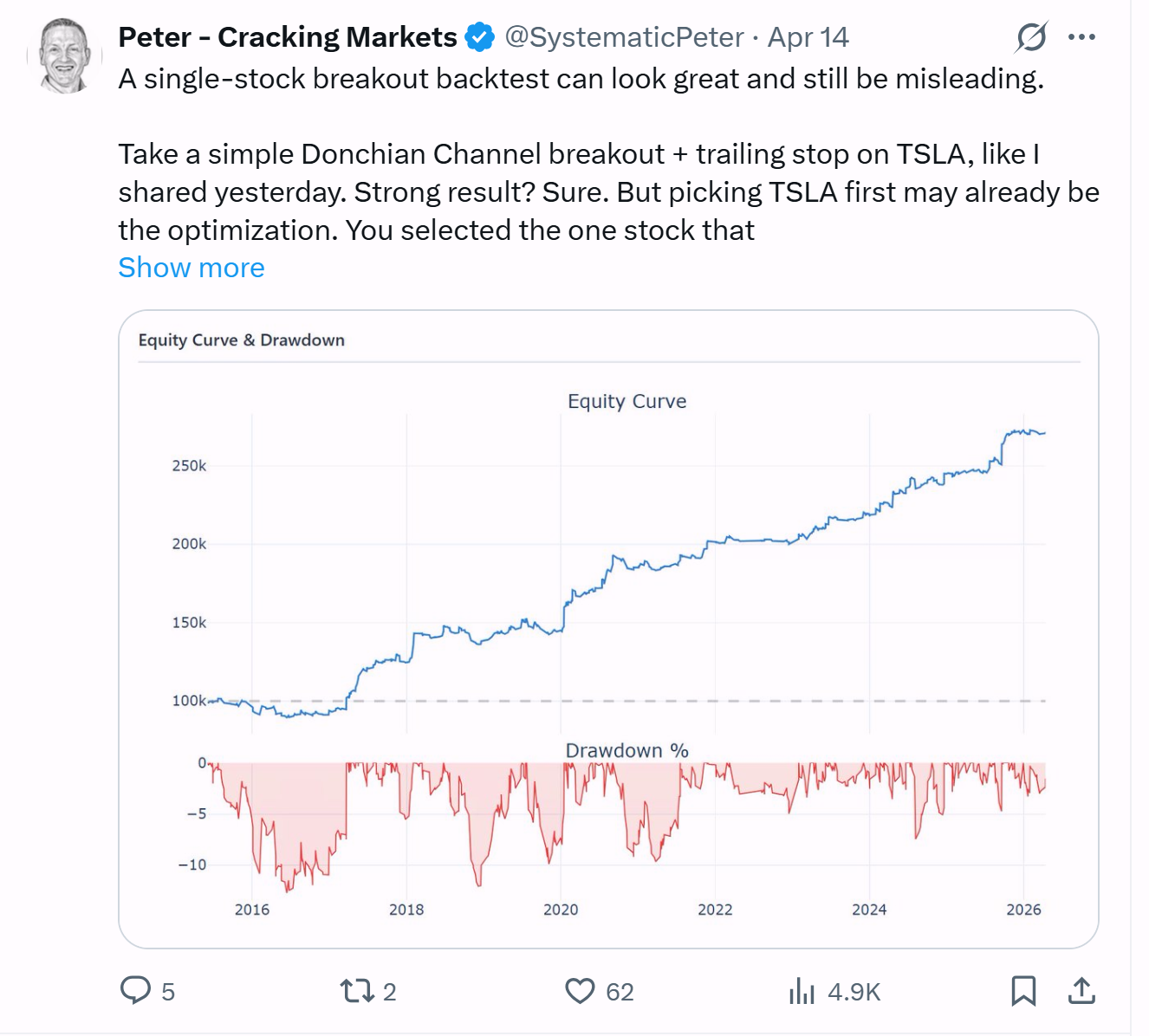
I am not targeting exactly the same positions as in rotational momentum, but they often overlap. In any case, my tests suggest that a similar approach can capture emotional market rallies very well, like the one currently taking place. Risk is managed with a trailing stop-loss; unlike rotational momentum, the position will be closed already at the first correction.
In the video, I show a specific example where, in MU stock - Micron - I hold both a long position from rotational momentum and a position through a swing breakout, where risk is managed by a trailing stop-loss.
A Donchian channel breakout with a trailing stop-loss is, at the same time, a very simple strategy that you can test yourself quite reliably, for example through an LLM backtest - which I recommend.
Layer 3: Intraday Breakout - During the Trading Day
The third piece of the momentum trading puzzle is an intraday strategy.
I describe the principle and logic of this particular system in the article Day Trading Volatility Breakouts Systematically. It is an intraday volatility breakout that trades both long and short. The tear sheet for the strategy mentioned in the video, including daily updates, is published here under Intraday Volatility Breakout.
Why This Works Better Over the Long Term Than Each Piece Separately
The three layers do not share the same risk. Rotation ties up capital for weeks, is very cheap to trade, and makes money in long trends. It is a very robust approach where there is little that can go wrong, but it cannot react to rapid fundamental changes.
The swing overlay captures sharp accelerations on the scale of days. It allows momentum exposure to be increased and reacts much faster to a trend change. That also means, however, that it is more expensive to trade in terms of fees and commissions. It is truly important to direct trades only into stocks with a high potential to move.
The intraday breakout works with clearly defined risk and leverage. If it catches a trend, it can generate solid profits. In addition, in indices, this time frame is the only one that has proven effective for me for shorting. As a result, the intraday breakout often helps during declines by compensating for losses from long positions in rotational momentum. Intraday trading, however, is the most expensive in terms of fees and commissions. The system must be genuinely selective in its trades.
Conclusion
If you want to see what the three layers of momentum look like live in the account - including specific positions from May 8, 2026 - watch the video above. I believe it can give you at least some interesting inspiration on how to approach this.